Citizens for Elmhurst Preservation is committed to protecting and celebrating our community’s rich history, charm and unique character.
One of our primary goals is to raise awareness of Elmhurst’s remarkable architectural heritage. This includes fostering a deeper understanding of the city’s diverse architectural styles, notable architects, periods of construction, and the influential local figures that helped shaped our community.
To support this goal, we are developing a series of Historic Neighborhood Overviews. These overviews are compiled using publicly available materials and are provided as a community service. It is part of our ongoing research into the history of Elmhurst and its neighborhoods.
The Emery and Struckmann Neighborhood
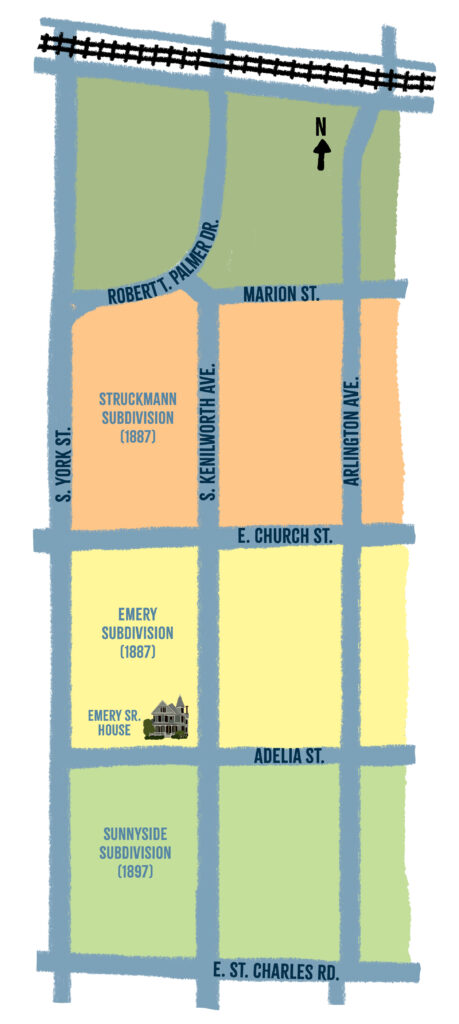
In late 1887, William Harrison Emery purchased approximately 70 acres of farmland north of St. Charles and east of York Road from Seth Wadham for $21,000. He immediately began planning the new subdivision. Emery’s Subdivision consisted of two blocks encompassing the east side of York Road and the east and west sides of what is now Kenilworth Avenue (then called Division Street), from Church Street to Adelia Street. He constructed an impressive Queen Anne residence for his own family (still standing!). Eight years later, in 1897, he added another subdivision just to the south of his first called Sunnyside.
Dietrich Struckmann‘s Subdivision was the second subdivision to be platted in the neighborhood, appearing just over a year after William Emery’s.
Struckmann accumulated the 67.5-acre parcel east of York Road, just north of Seth Wadhams’ farm. Struckmann’s Subdivision consisted of two blocks on the east side of York Road and the east and west sides of Kenilworth Avenue, between Marion Avenue and Church Street. He lived with his family at 225 S. York Street, a residence that has since been razed.
Resources*
We invited you to download a PDF of the neighborhood overviews to use as a reference or as a guide for taking walking tours.
Citizens for Elmhurst Preservation is committed to protecting and celebrating our community’s rich history, charm and unique character.
One of our primary goals is to raise awareness of Elmhurst’s remarkable architectural heritage. This includes fostering a deeper understanding of the city’s diverse architectural styles, notable architects, periods of construction, and the influential local figures that helped shaped our community.
To support this goal, we are developing a series of Historic Neighborhood Overviews. These overviews are compiled using publicly available materials and are provided as a community service. It is part of our ongoing research into the history of Elmhurst and its neighborhoods.
The Emery and Struckmann Neighborhood
In late 1887, William Harrison Emery purchased approximately 70 acres of farmland north of St. Charles and east of York Road from Seth Wadham for $21,000. He immediately began planning the new subdivision. Emery’s Subdivision consisted of two blocks encompassing the east side of York Road and the east and west sides of what is now Kenilworth Avenue (then called Division Street), from Church Street to Adelia Street. He constructed an impressive Queen Anne residence for his own family (still standing!). Eight years later, in 1897, he added another subdivision just to the south of his first called Sunnyside.
Dietrich Struckmann‘s Subdivision was the second subdivision to be platted in the neighborhood, appearing just over a year after William Emery’s.
Struckmann accumulated the 67.5-acre parcel east of York Road, just north of Seth Wadhams’ farm. Struckmann’s Subdivision consisted of two blocks on the east side of York Road and the east and west sides of Kenilworth Avenue, between Marion Avenue and Church Street. He lived with his family at 225 S. York Street, a residence that has since been razed.
Resources*
We invited you to download a PDF of the neighborhood overviews to use as a reference or as a guide for taking walking tours.
Citizens for Elmhurst Preservation is committed to protecting and celebrating our community’s rich history, charm and unique character.
One of our primary goals is to raise awareness of Elmhurst’s remarkable architectural heritage. This includes fostering a deeper understanding of the city’s diverse architectural styles, notable architects, periods of construction, and the influential local figures that helped shaped our community.
To support this goal, we are developing a series of Historic Neighborhood Overviews. These overviews are compiled using publicly available materials and are provided as a community service. It is part of our ongoing research into the history of Elmhurst and its neighborhoods.
The Emery and Struckmann Neighborhood
In late 1887, William Harrison Emery purchased approximately 70 acres of farmland north of St. Charles and east of York Road from Seth Wadham for $21,000. He immediately began planning the new subdivision. Emery’s Subdivision consisted of two blocks encompassing the east side of York Road and the east and west sides of what is now Kenilworth Avenue (then called Division Street), from Church Street to Adelia Street. He constructed an impressive Queen Anne residence for his own family (still standing!). Eight years later, in 1897, he added another subdivision just to the south of his first called Sunnyside.
Dietrich Struckmann‘s Subdivision was the second subdivision to be platted in the neighborhood, appearing just over a year after William Emery’s.
Struckmann accumulated the 67.5-acre parcel east of York Road, just north of Seth Wadhams’ farm. Struckmann’s Subdivision consisted of two blocks on the east side of York Road and the east and west sides of Kenilworth Avenue, between Marion Avenue and Church Street. He lived with his family at 225 S. York Street, a residence that has since been razed.
Resources*
We invited you to download a PDF of the neighborhood overviews to use as a reference or as a guide for taking walking tours.